|
You are only seeing a fraction of my work. If you want to see it all join my Patreon page at https://www.patreon.com/itsmetoo If you are already a supporter, go to the Table Of Contents on my Patreon and click the proper link to get the new password. |
Captioned Images Series: Staying Forever
Created: 07/04/2025
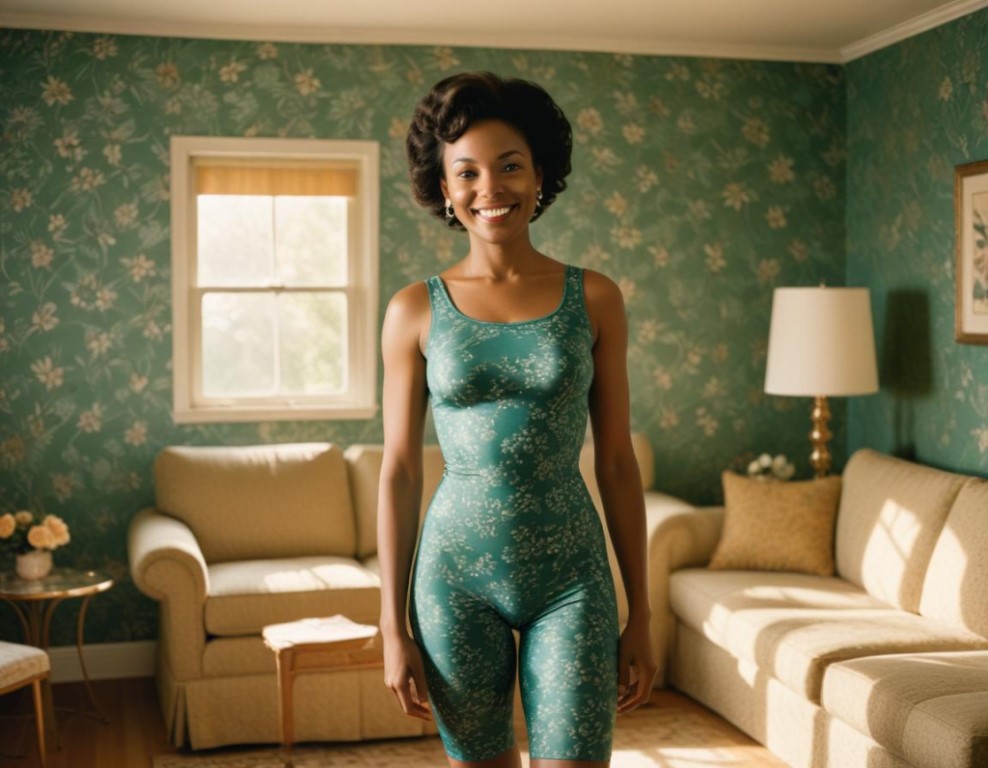
Hector looked around and smiled, though uneasily. The whole thing felt astonishingly real—too real. He blinked at the soft flicker of light from the lamp beside him, the bulb glowing faintly yellow in the dim living room. The air smelled faintly of lemon polish and old upholstery. The two worn couches were placed neatly around a polished coffee table. On the end tables sat doilies and black-and-white framed photos. No television. No radio playing pop music. No phone in sight.
He glanced down at his body again, something he had done about ten times already since becoming conscious here. Slender, shapely legs stretched from beneath high-waisted floral bike shorts. His skin was a smooth brown, glowing under the soft light. His hips curved in ways that made him shift awkwardly on the sofa cushion. He reached up and touched the gold hoop earrings swinging gently at his ears and then the soft, permed curls that crowned his head. He could feel them. He could feel everything.
“It’s just a simulation,” he said aloud, his voice high and musical. He smiled again, more nervously now. “Incredibly detailed… very immersive.”
He stood and walked toward the mirror over the fireplace, heels clicking on the linoleum floor. The woman staring back at him was beautiful and strong, with an elegance that startled him. Her eyes held a glimmer of his confusion and intelligence. “Okay, Hector,” he said to the mirror, steadying himself, “You’re living in a simulation set in 1953. Probably a consciousness experiment. Maybe temporal-psychological immersion. It’ll end soon.”
But it didn’t.
The next few days were… revealing.
The clothes in the wardrobe were vintage, of course: flared skirts, smart blouses, stockings with seams, girdles, and low-heeled shoes. He’d changed out of the shorts and into a floral day dress with puffed sleeves and a cinched waist. It flattered his new form beautifully. The first time he stepped outside in it, an older white man tipped his hat with a patronizing smile that didn’t reach his eyes. Later, a young white woman clutched her purse tighter when Hector passed on the sidewalk.
He smiled politely, but the coldness, the suspicion—it hit deep. It was real. Not coded, not controlled responses from an AI. It was human.
Over the following weeks, Hector learned to move with grace, to wear gloves in the morning, to keep his hair neat and his voice gentle when speaking in shops. He learned the subtle art of making himself smaller so he wouldn’t be seen as a threat. His body was admired by some and judged by others. Black men looked at him with curiosity. White men didn’t look at him at all, and when they did, it was only to remind him of what line not to cross.
One afternoon, he was refused service at a diner. Another day, a neighbor—a black woman named Loretta—scolded him for “walking around like you own the place.” He realized the performance he had to keep up was not just for others, but for survival. Every action had weight.
Still, there were joys. The music—Ella Fitzgerald and Nat King Cole. The fashion. The sense of community among other black women who whispered their truths when no white ears were listening. He learned to laugh differently. Cry differently. Dance barefoot in the kitchen while stirring grits. It was not what he expected. It was more.
Yet, even with acceptance came the burning need to go back.
Weeks turned to months. And finally, on what he thought might be the one-year mark, Hector found himself in front of a mirror again, clutching a pendant around his neck he hadn't remembered putting on. It shimmered strangely—out of place, like it belonged to the future.
“This is it,” he whispered. “The exit point.”
He pressed it.
Nothing happened.
He tried again, more desperately.
Nothing.
He looked up at his reflection. The face looking back at him was calm, dignified, and utterly female. The eyes had changed—less panic, more acceptance—but still filled with longing.
“No... no, no, no,” Hector breathed, stepping back. “End simulation. End simulation.”
But the air did not shimmer. There was no loading screen. No voice saying "Returning to present time." There was only the distant sound of children playing stickball in the street, the soft chirping of birds, and the warmth of sunlight through lace curtains.
The simulation was not a simulation.
He was a black woman in 1953.
And he was staying.
Forever.
Made with Freepik Generator